
FIG. 01From idea to impact
Atwater
From AI idea to AI impact.
Atwater takes companies from scattered AI experiments to AI in daily use, with results you can measure.
Bill of materials Each with a length
- Drawing
- AB-001
- Unit
- Atwater
- Scale
- 1 : 1
- Title
- From AI idea to AI impact
- Sheet
- 01
( 01 )Who we are
Start from the work, not the model.
- ( 01 )
A multidisciplinary AI consulting firm: strategy, engineering and adoption in one team. We lead with Claude, and work with OpenAI and other models where they fit the work.
- ( 02 )
Most AI stalls between the demo and daily use. The gap is rarely the model: it is the process, the data and the people around it.
- ( 03 )
So we automate one step at a time, a person still checking, and measure one number before and after, such as time to reply. Every engagement ends with your team running the work. Growing and mid-market companies first. In English and French.
FIG. 02 · DETAIL A Process mapThree disciplines, five steps
( 02 )The challenge
Everyone uses AI. Almost no one runs on it.
( Challenge 01 )
Use is not maturity.
AI is part of most leaders' week. Very few companies say it is built into how they work.
82% of enterprise leaders use gen AI at least weekly. 1% of leaders call their companies mature in how they deploy AI.
( Challenge 02 )
Your people are ahead of your plan.
Employees use AI on their own, well before a plan, a policy or a budget reaches them.
Leaders estimate 4% of employees use gen AI for at least 30% of their daily work. 13% of employees say they do.
( Challenge 03 )
Done right, it pays.
Returns come when each use case is tied to a number the business already watches.
74% of enterprise leaders report a positive return on gen AI.
( Sources ) 01, 03: Wharton and GBK Collective, Accountable Acceleration, 2025. 01, 02: McKinsey, Superagency in the workplace, 2025. Each share is drawn as a grid of a hundred dots.
( 03 )Adoption
Access is not adoption.
Adoption is the work.
Buying licences is the easy part. The hardest part of enterprise AI is changing how people work, and keeping it changed. Our method comes from research on how organizations adopt new technology, including doctoral research on generative AI, and from leading customer success and AI adoption at cloud and AI companies.
FIG. 03 From access to valueFour stages, one gap
- 01AccessLicences and tools in place.
- 02TrialFirst use, by role.
- 03HabitWeekly use in a real workflow.
- 04ValueThe one number moves.
( 01 )
Useful in my own work.
What research shows
People adopt a tool when it helps their own tasks and feels easy to use.
What we do
Training by role, on each team's real tasks, never a generic demo.
( 02 )
Peers move peers.
What research shows
Uptake spreads through trusted colleagues more than through mandates.
What we do
A champion in every team, with time set aside and a direct line to us.
( 03 )
Conditions, not willpower.
What research shows
Support, clear rules and time to learn decide whether a trial becomes a habit.
What we do
A plain-language use policy, office hours, and leaders who use the tools in the open.
( 04 )
Measured, not assumed.
What research shows
Logins say little about adoption. What matters is whether the work changed.
What we do
A monthly scorecard: active use, depth of use, and the one number the work was meant to move.
( Grounded in ) The Technology Acceptance Model (Davis, 1989), the Unified Theory of Acceptance and Use of Technology (Venkatesh et al., 2003) and Diffusion of Innovations (Rogers, 1962).
Adoption is where our research lives.Read our research
( 04 )Artifacts
One template, built and working.
Built from working code, not slides. The same pattern fits any team that makes the same decisions every week on data it already has, and we fit it to your systems.
BRnX · OpportunitiesIllustrative data 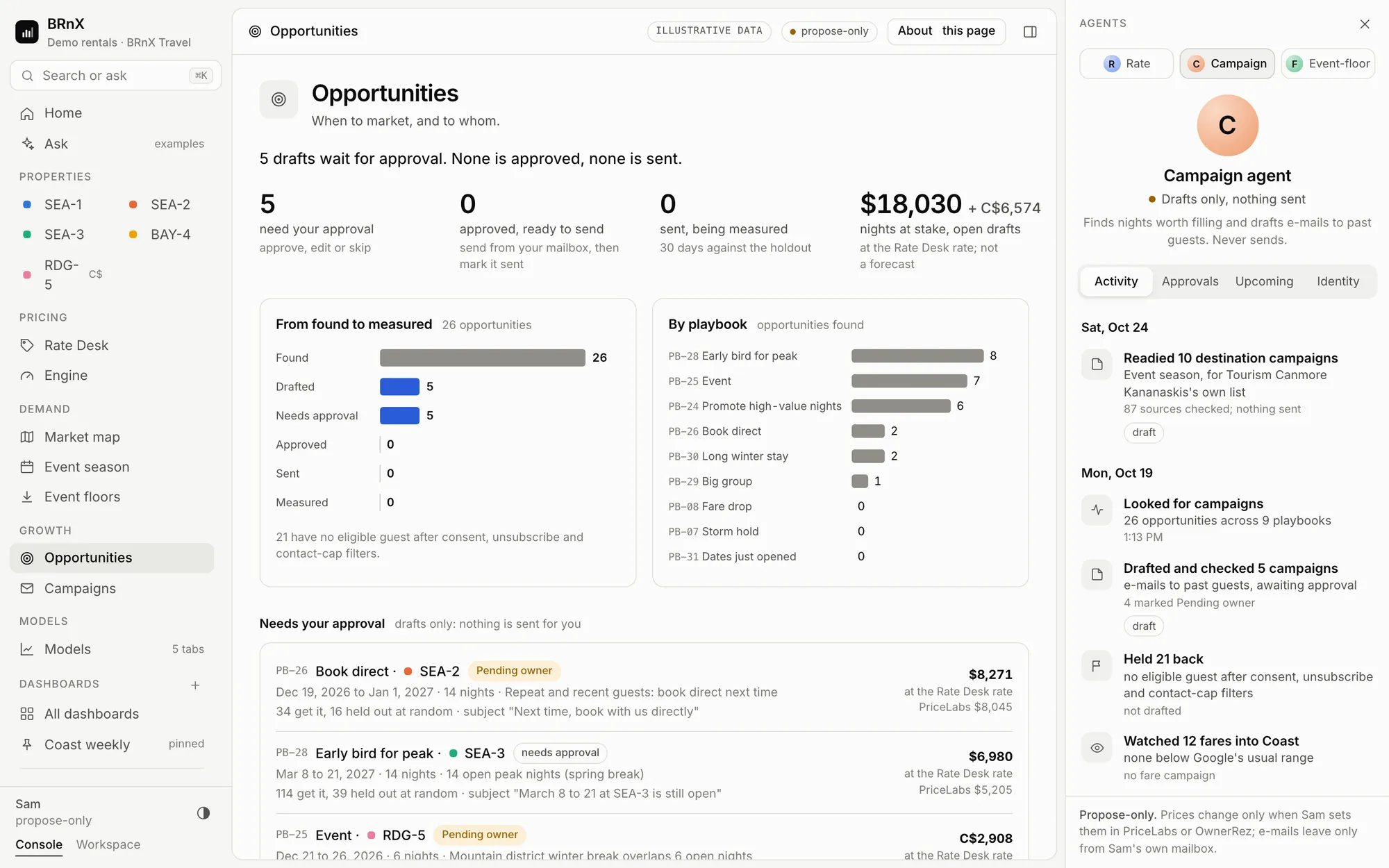
BRnX Travel, built on the ultrarr kernel
For BRnX Travel's short-term rentals, agents built on Claude find the nights worth filling and draft emails to past guests, and never send one. 15 of its playbooks load unchanged in the ultrarr kernel.
What the tools are
- Night by night
- Every night ahead forecast against the market; the agent drafts the change, a person makes it.
- Opportunities
- When to market, and to whom: nights worth filling, with emails to past guests drafted, never sent.
- Event floors
- A floor for the busy dates around each property, applied only after a named person approves it.
- Ask
- Questions in plain language, answered from the bookings and the market.
- What you get
- The template running on your data, in your systems, with its screens, agents and plays.
- What you tune
- The plays, the thresholds and who approves what, until it fits the way your team works.
- What you own
- The prompts, the agents and the know-how. No new platform to buy and no lock-in.
Bring the process you want to run this way.Book a working session
( 05 )Services
The problem picks the service.
Six services, one team from strategy to daily use, so nothing is lost between the plan, the build and the people who run it.
S1The people
Adoption and change management
Change management for AI, from rollout to habit: training by role, a champion in every team, and a monthly scorecard that shows whether the work changed. For Claude, ChatGPT or Copilot.
- Rollout and training by role
- Champions and centre of excellence
- Adoption scorecard
S2The guardrails
Governance and security
The policies and controls that let AI run on real data: who can use what, what gets logged, who approves, and how each model and vendor is reviewed.
- AI use policy and risk register
- Data, access and security controls
- Model and vendor review
S3The method
Strategy and frameworks
Where you stand on AI, which use cases pay first, and a roadmap with business cases your leadership can fund.
- AI readiness diagnostic
- Strategy and roadmap
- Business case by use case
S4The build
Custom tools and products
AI tools, agents and products built on your data and connected to your CRM, documents and systems, with a person approving what reaches a customer.
- Agents and workflows
- Connectors and APIs
- Prototype to product
S5The model
Model customization
Models adapted to your business: retrieval on your own documents, fine-tuning where it pays, and evaluations that prove a model is right for the job before it ships.
- Retrieval on enterprise data
- Fine-tuning and distillation
- Evaluation and model selection
S6The customer
Customer journeys
Customer journeys redrawn with AI at each step, from first contact to renewal, including for software vendors whose customers must adopt the AI they ship.
- Journey mapping
- Onboarding by role
- Renewal plays
( 06 )Governance
Governance that lets people say yes.
Clear rules are what let a team use AI on real data. We set them up with you, sized to your risk, and aligned with the frameworks your auditors and regulators already use.
What we put in place
- 01An AI use policy in plain language
- 02A risk register, with each use case tiered by risk
- 03Data, access and security controls
- 04Model and vendor reviews
- 05A person approving anything that reaches a customer or a citizen
- 06An audit trail and a review cadence
Aligned with
- NIST AI Risk Management Framework
- ISO/IEC 42001
- Quebec Law 25
For federal and public-sector work
- Directive on Automated Decision-Making
- Algorithmic Impact Assessment
- Guide on the Use of Generative AI
Federal departments must complete an Algorithmic Impact Assessment before an automated decision system goes into production. We help teams scope systems against the Directive, complete the assessment and put the required safeguards in place.
( 07 )Engagements
Every engagement has a length.
Written down before it starts.
Most AI services firms never say how long an engagement runs; where they do, pilots start at four weeks and embedded teams are sold by the quarter. Ours start at ten minutes, and each step is sold on its own.
Ten minutes, five dimensions, a clear next step. Take it now
Five days to an opportunity map.
One week to the first working automation.
Four weeks to move the automations into daily use and hand them to your team.
The strategist seat on your AI program, by the month: plan, rhythm, gates and the decisions they need.
( For software vendors )
( 08 )Commitments
Three commitments on every engagement.
- 01
A length, written down
Every engagement has a fixed length and named deliverables before it starts. No open-ended discovery.
- 02
One number per use case
Each use case is judged by one metric, measured before the build and again after it.
- 03
Yours at the end
The work runs in your systems and accounts. At handover your team owns the prompts, the agents and the documents.
( 09 )Research
Research behind the work.
Atwater studies how organizations adopt generative AI: why access so rarely becomes impact, and what changes that. What we learn goes straight into how we run engagements.
- Adoption at work
- How generative AI moves from trial to habit inside teams, and what predicts the move.
- Change management for AI
- What leaders, champions and training actually change, measured in how the work gets done.
- Governance in practice
- How rules, approvals and risk reviews help or slow adoption, in companies and in the public sector.
Latest · Carousel · November 2026
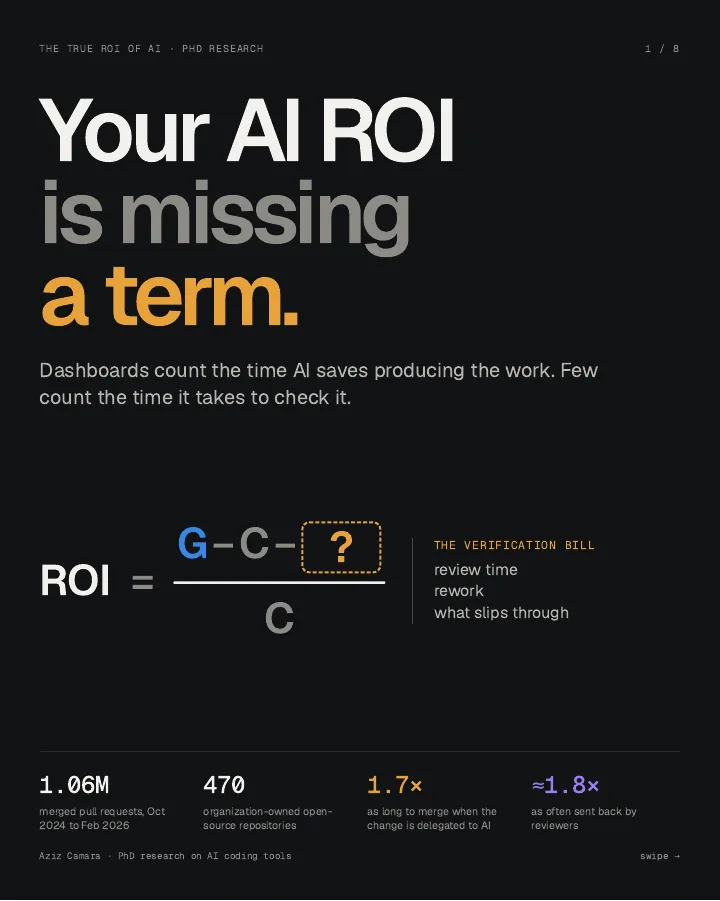
The true ROI of AI
Dashboards count the time AI saves producing the work. Few count the time it takes to check it. Our latest research adds the missing term: the verification bill.
- 1.06Mmerged pull requests studied
- 1.7×as long to merge when the change is delegated to AI
- ≈1.8×as often sent back by reviewers
Notes and working papers are published as they are ready.Visit Atwater Research
( 10 )Experience
Where the experience comes from.
Our team has worked with and for organizations across AI research, cloud software, security, banking, retail and academia.
( 11 )Stack
Claude first, and the right model for each job.
Built on the tools you already pay for: Claude first, OpenAI and other models where they fit, on their own or through your cloud, connected to the systems your teams use every day.
No new platform to buy and no lock-in. The prompts, the agents and the know-how stay yours.
Claude, first
- Claude for Teams
- Claude Enterprise
- Claude Code
- Claude Cowork
- Claude API
- Claude Agent SDK
Other models
- OpenAI API
- ChatGPT Enterprise
- Google Gemini
- Open-weight models
Where it runs
- Claude, direct
- Amazon Bedrock
- Google Vertex AI
- Microsoft Foundry
- MCP connectors
- Your own cloud
What it connects to
- Microsoft 365
- Google Workspace
- Salesforce
- HubSpot
- ServiceNow
- Zendesk
- Slack
- SharePoint
- Jira
- Notion
- Snowflake
- BigQuery
Book a working session.
Book a 30-minute discovery call: your goals, where AI could pay, and whether we are a fit.
Bring one use case
The work you would hand to AI first, and how you would know it worked.
Leave with a written scope
A fixed length, the deliverables and the metric the work will be judged by.
Start where it fits
The ten-minute assessment, the diagnostic, or straight into a build if you know where to begin.